Screen Printing vs Embroidery, DTG & DTF: Which Is Best?
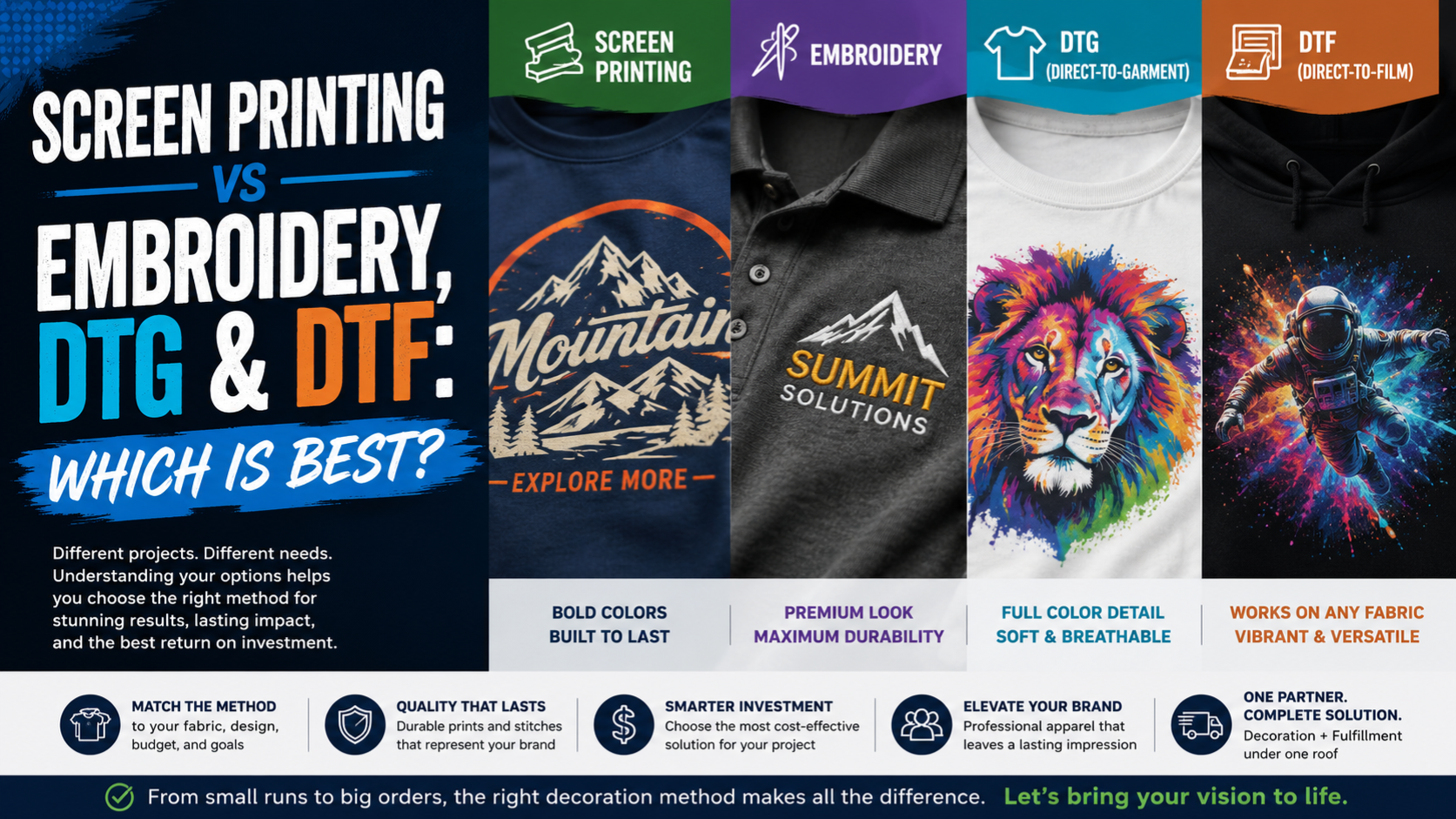
To choose the best custom apparel printing method, match your specific project needs to the ideal technology. Choose screen printing for high-volume, limited-color orders. Choose embroidery for durable, professional corporate wear. Choose DTG for detailed, low-volume cotton apparel, and choose DTF for vibrant graphics on diverse or difficult synthetic fabrics.
The custom apparel printing market is rapidly expanding, with the global custom t-shirt printing market size valued at USD 5.16 billion in 2024 and expected to grow at a compound annual growth rate of 11.5% through 2030. Businesses understand that high-quality branded company apparel is a powerful tool for building recognition, reinforcing core values, and leaving lasting impressions on customers and employees alike.
However, navigating the complex world of garment decoration requires understanding the specific technologies available. Between traditional techniques and modern digital innovations, business owners often struggle to identify which custom apparel printing method will deliver the best return on investment. The right choice depends entirely on your design complexity, order volume, fabric type, and durability requirements.
This comprehensive guide breaks down the core differences between screen printing, embroidery, Direct-to-Garment (DTG), and Direct-to-Film (DTF) technologies. By understanding the unique advantages and limitations of each custom apparel printing method, you can make informed decisions that elevate your brand and delight your customers.
How does screen printing work, and what are its pros and cons?
Screen printing remains the foundational custom apparel printing method for high-volume orders. The process involves creating a stencil (or screen) for each color in your design. Decorators push thick ink through these stencils directly onto the garment using a squeegee. Because each color requires a separate screen and setup, the initial preparation takes time, but the actual printing process is incredibly fast.
Pros of screen printing:
- Maximum durability: Screen printing inks penetrate deeply into the fabric. Properly cured screen prints will easily outlast the garment itself.
- Vibrant colors: This method produces exceptionally bright, opaque colors, even on dark fabrics.
- Cost-effective at scale: Once the screens are set up, printing hundreds or thousands of shirts is highly economical.
Cons of screen printing:
- Color limitations: Because decorators must burn a separate screen for each color, highly complex or photographic designs become prohibitively expensive.
- High setup costs: The extensive manual preparation means this method is not cost-effective for small runs or one-off orders.
Best use cases:
Choose
screen printing if you need hundreds of promotional t-shirts, team uniforms, or event apparel with simple, bold, one- to four-color graphics.
What makes embroidery the best choice for professional apparel?
Embroidery bypasses ink entirely, using automated sewing machines to stitch your design directly into the fabric. The process requires "digitizing" your artwork, which translates the design into specific stitch types, directions, and thread counts that the embroidery machine can read.
Pros of embroidery:
- Premium aesthetic: Thread adds a three-dimensional texture that looks highly professional and authoritative.
- Extreme durability: Polyester and rayon threads will not fade, crack, or peel, making embroidery the most durable custom apparel decoration method available.
- Perceived value: Embroidered garments carry a higher perceived value, ideal for client gifts or executive wear.
Cons of embroidery:
- Higher production costs: Pricing depends on the stitch count. Large designs require more thread and machine time, significantly increasing the cost.
- Detail limitations: Needles and thread cannot recreate tiny text, color gradients, or minute photographic details.
- Fabric restrictions: Heavy stitching can pucker or distort thin, lightweight fabrics.
Best use cases:
Choose
embroidery if you are decorating polo shirts, corporate jackets, structured hats, or heavy sweatshirts that require a polished, long-lasting brand presence.
When is Direct-to-Garment (DTG) the right solution?
Direct-to-Garment (DTG) printing operates much like a standard office inkjet printer, but it is specifically engineered for textiles. The machine applies water-based inks directly into the garment's fibers. For dark garments, decorators apply a liquid pre-treatment to ensure the white underbase and colored inks bond correctly to the fabric.
Pros of DTG printing:
- Unlimited colors: DTG easily handles full-color photographs, intricate gradients, and highly detailed artwork without any extra setup costs.
- Low minimums: Because there are no screens to burn, you can print a single custom shirt cost-effectively.
- Soft hand feel: The water-based inks absorb into the fabric, resulting in a print that feels incredibly soft and breathable.
Cons of DTG printing:
- Fabric limitations: DTG performs best on 100% cotton garments. It struggles to adhere properly to polyester or heavy synthetic blends.
- Slower production: The printing process itself is slower than screen printing, making it more expensive per unit at high volumes.
Best use cases:
Choose
DTG printing if you run an e-commerce fashion brand, need small batches of highly detailed graphic tees, or require one-off custom merchandise on cotton apparel.
Why is Direct-to-Film (DTF) transforming custom apparel?
Direct-to-Film (DTF) is the versatile newcomer to the apparel decoration industry. In this process, the design is digitally printed onto a special PET film. The printer applies a powder adhesive to the wet ink, which is then cured. Finally, the decorator uses a commercial heat press to transfer the design from the film onto the garment. The digital textile printing market is growing rapidly, with DTF alone recently surpassing $2.7 billion in market size.
Pros of DTF printing:
- Ultimate fabric versatility: Unlike DTG, DTF prints adhere beautifully to 100% polyester, nylon, fleece, blends, and even treated leather.
- Vibrant and precise: DTF delivers exceptionally sharp details and vibrant colors that pop on any garment background.
- High durability and stretch: The transferred design stretches effortlessly with the garment, preventing cracking on activewear.
Cons of DTF printing:
- Plastic hand feel: Because the design sits on top of the fabric as a continuous layer, large graphics can feel slightly heavier and less breathable than DTG or water-based screen printing.
- Newer technology: While early wash tests show excellent durability, it lacks the decades of historical data that screen printing possesses.
Best use cases:
Choose
DTF printing if you need complex, full-color designs placed on sportswear, synthetic fabrics, or uniquely shaped items like tote bags and sleeves.
How do these custom apparel printing methods compare side by side?
To make an informed decision, businesses must compare these methods across several operational metrics.
Cost analysis based on order volume
For high-volume orders, screen printing offers the lowest cost per unit. The initial setup cost is easily absorbed by the sheer quantity of garments. For low-volume orders or on-demand fulfillment, DTG and DTF are far more economical because they eliminate setup fees. Embroidery costs remain relatively stable regardless of volume, as the primary cost drivers are stitch count and machine runtime.
Durability comparison
Embroidery is universally recognized as the most durable custom apparel decoration method, easily surviving heavy laundering and industrial environments. Screen printing closely follows, providing excellent longevity if the ink is cured properly. DTF offers strong durability and flexibility, specifically on synthetic athletic wear. DTG is durable but may show slight fading over time with repeated washes due to the nature of water-based inks on cotton.
Aesthetic and design flexibility
If your branded company apparel features a simple, solid-color logo, screen printing delivers crisp, bold results. If your artwork includes full-color photographs, intricate shading, or complex gradients, you must use DTG or DTF. If you want a textured, classic corporate aesthetic, embroidery is the only logical choice.
Fabric compatibility
Match the technology to the textile. Use DTG exclusively for 100% cotton or high-cotton blends. Use DTF for challenging synthetics, activewear, and moisture-wicking polyesters. Use screen printing for standard cotton, blends, and basic polyesters. Use embroidery for heavy, structured fabrics like canvas, twill, and fleece.
What factors should you consider when choosing a decoration method?
When planning your custom apparel project, evaluate your requirements against these specific decision criteria.
1. Budget and order quantity:
Choose screen printing if you have a large budget for a massive bulk order of simple shirts. Choose DTG or DTF if you need a low-risk, small-batch order.
2. Design complexity and color requirements:
Review your brand guidelines. If your logo uses six colors and a gradient, screen printing will require six separate screens, which drives up costs. In this scenario, digital printing (DTG or DTF) handles the complexity seamlessly.
3. Fabric type:
If you are outfitting a construction crew in heavy safety jackets, embroidery provides the necessary ruggedness. If you are launching a marathon running team, DTF handles the stretchy polyester performance wear perfectly.
4. Desired look and feel:
Consider the end-user experience. Retail fashion brands often prefer the soft, breathable feel of DTG on premium cotton. Corporate environments favor the polished, raised texture of embroidery.
What practical tips ensure a successful apparel project?
Working with a professional decorator guarantees that your branded company apparel meets your precise standards.
Prepare your artwork correctly:
Always provide vector files (.AI, .EPS, or .SVG) for screen printing and embroidery. Vector files maintain perfect clarity at any size. For DTG and DTF, provide high-resolution raster files (.PNG or .TIFF) at 300 DPI with a transparent background.
Partner with a reputable decorator:
At
Silverscreen Decoration & Fulfillment, we blend American craftsmanship with cutting-edge technology to ensure your brand shines. With over 110 dedicated garment decorators and more than 56,000 square feet of production space at our Reno, NV facility, we have the scalable capacity to handle any-sized project. We streamline your entire decoration process under one roof, offering screen printing, embroidery, DTG, and DTF, alongside comprehensive fulfillment services.
Request proofs and samples:
Before committing to a massive production run, always review digital proofs to verify placement and sizing. For large investments, requesting a physical sample ensures the fabric drape, ink color, and overall aesthetic align with your brand standards.
Elevate your brand with the right custom apparel
Choosing the right custom apparel printing method does more than turn heads; it builds connections, amplifies your message, and drives your business forward. By evaluating your order volume, design complexity, fabric requirements, and durability needs, you can easily identify whether screen printing, embroidery, DTG, or DTF is the superior choice for your project.
Your brand has a story to tell, and custom apparel is one of the most visible ways to share it. Partner with a scalable, high-volume production expert that understands the nuances of every decoration technique. When you are ready to bring your vision to life with flawless accuracy, reach out to the experts at Silverscreen Decoration & Fulfillment to discuss your next apparel project.
Frequently Asked Questions (FAQ)
What is the difference between screen printing and embroidery?
Screen printing uses stencils to push liquid ink directly onto the surface of a garment, making it ideal for large graphics and high-volume orders. Embroidery uses automated sewing machines to stitch thread into the fabric, providing a textured, premium look that is highly durable but limited to simpler, smaller designs like left-chest corporate logos.
When should I use DTG instead of screen printing?
Choose DTG instead of screen printing when you need to print highly detailed, full-color designs (like photographs or gradients) on small batches of 100% cotton garments. DTG has no setup costs per color, making it highly cost-effective for one-off prints, whereas screen printing requires expensive setup for every color and is only economical for high-volume orders.
What is the most durable custom apparel decoration method?
Embroidery is the most durable custom apparel decoration method. Because the design is physically stitched into the garment using tough polyester or rayon threads, it will never crack, peel, or fade, and will typically outlast the garment itself.
Which printing method is best for company uniforms?
The best method for company uniforms depends on the work environment. Choose embroidery for professional office polos and heavy-duty industrial jackets for its durability and premium aesthetic. Choose screen printing for high-volume staff t-shirts in casual or service-industry settings.