Scaling Large Custom Apparel Orders Without Losing Quality
Scaling large custom apparel orders without sacrificing quality requires the right contract screen printing partner, clearly defined production standards, and a fulfillment infrastructure built for volume. Key factors include production capacity, quality control processes, decoration versatility, and technology-driven order management.
Scaling custom apparel production sounds straightforward, until it isn't. You land a large order, commit to a timeline, and suddenly you're navigating inconsistent print registration, delayed shipments, and garments that don't match the original sample. For brands, promotional product distributors, and corporate buyers, these failures aren't just frustrating.
They're costly.
The good news? Scaling large apparel orders without quality loss is absolutely achievable.
The difference between a smooth, high-volume run and a logistical nightmare comes down to one thing: preparation. That means choosing the right contract screen printing partner, understanding what production capacity actually looks like at scale, and building in quality checkpoints before a single garment ships.
This guide covers everything you need to know, from evaluating a print partner's infrastructure to the specific questions you should ask before committing to a large custom apparel production run.
How Do Companies Handle Large Custom Apparel Orders?
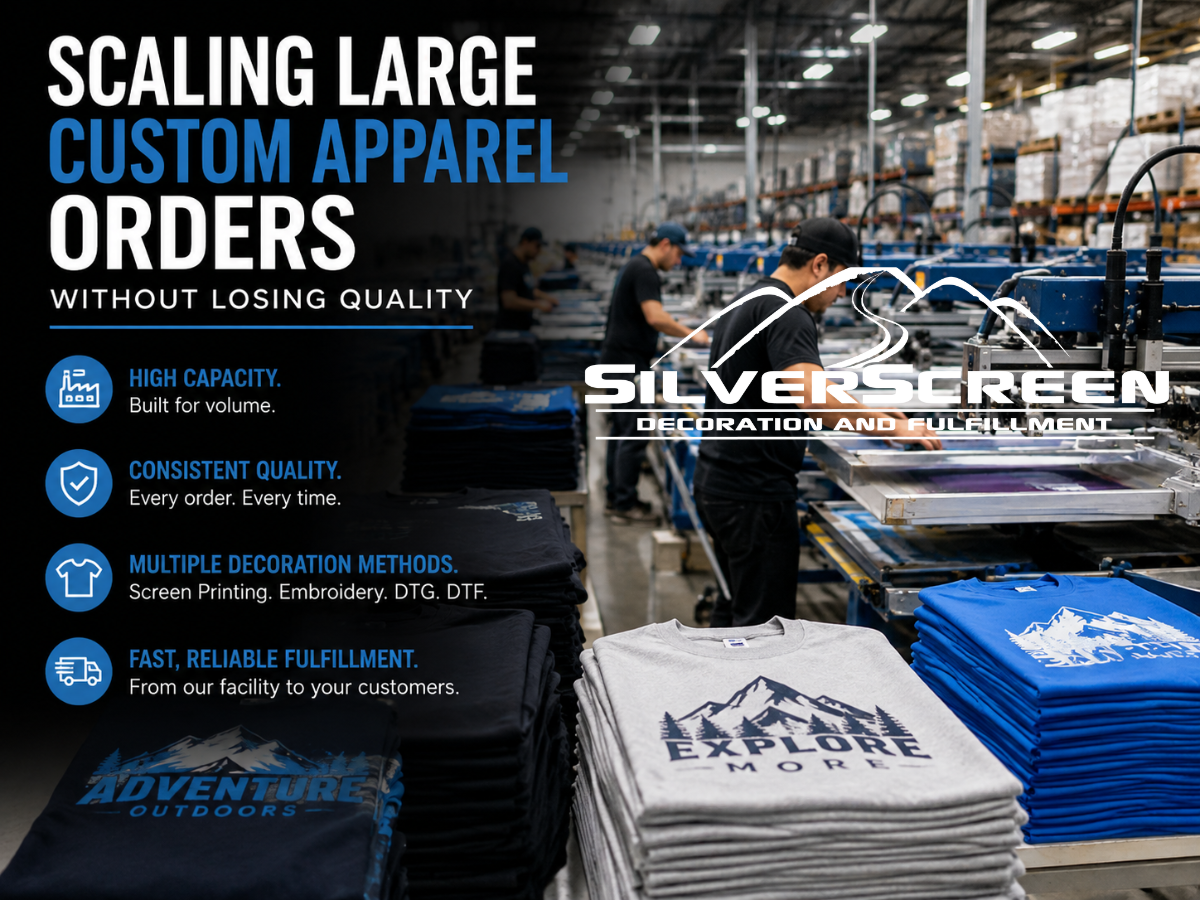
Companies that consistently deliver on large custom apparel orders share a few common traits. They don't wing it. High-volume screen printing operations rely on standardized workflows, dedicated production shifts, and clearly documented quality benchmarks that apply to every order, regardless of size.
At an operational level, handling large apparel orders typically involves:
- Pre-production proofing to lock in design specifications before any screens are burned or garments touched
- Ink mixing and color matching conducted in a controlled environment to ensure consistency across thousands of units
- Multi-stage quality inspections at key production milestones, not just at the end of a run
- Dedicated account management so that communication doesn't break down when production is at full capacity
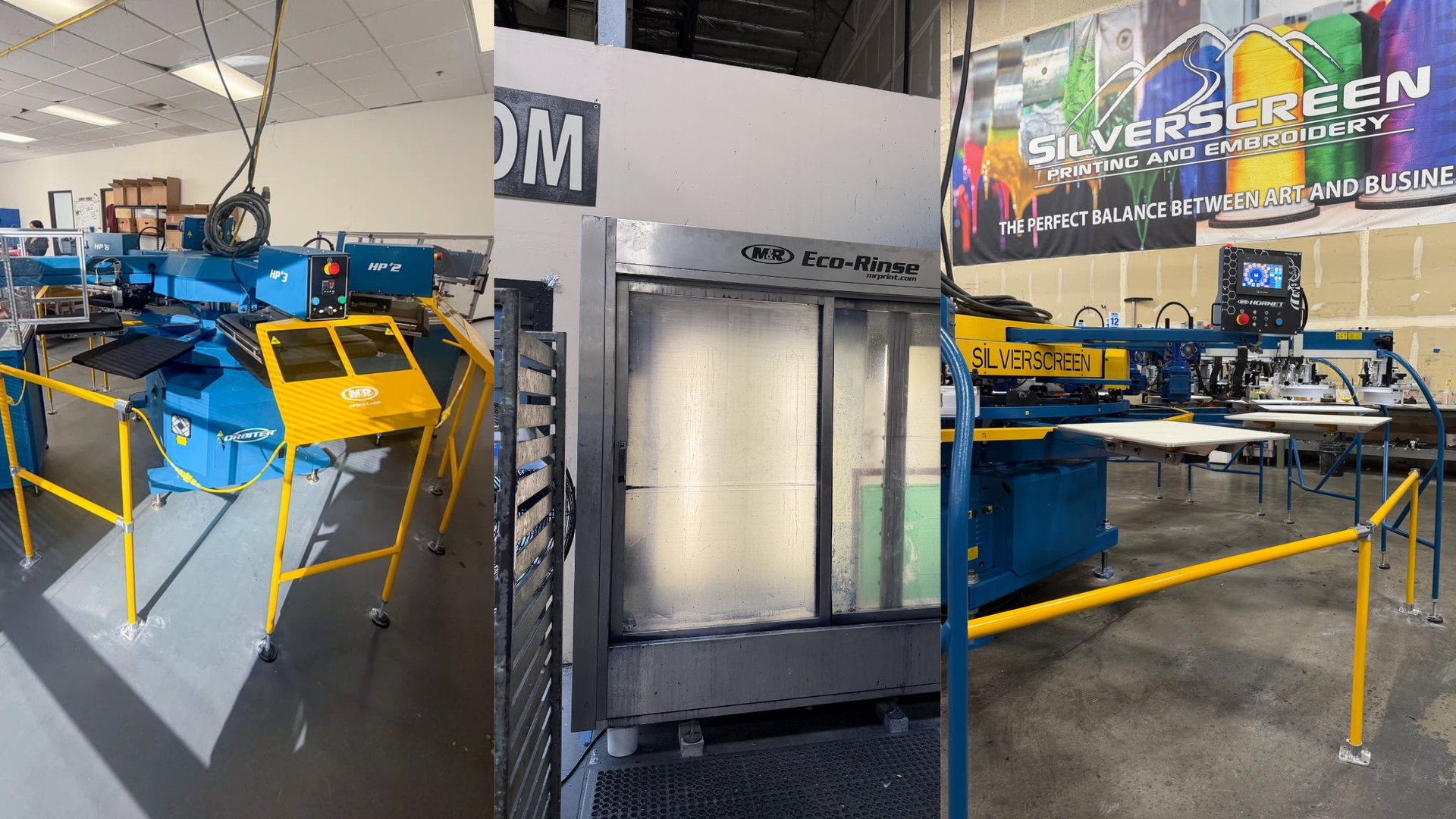
The scale of the facility matters too. A print shop running one shift with a handful of presses operates very differently from a production floor with over 110 dedicated garment decorators and 56,000+ square feet of production space running two shifts. Volume requires infrastructure, and infrastructure requires investment.
What Should You Look for in a Contract Screen Printer?
Does the decorator have proven high-volume screen printing capacity?
This is the first question to ask, and the answer needs to be specific. "We can handle large orders" is not an answer. Ask for details: How many presses do you operate? What's your daily output capacity? Can you run two shifts if needed?
A contract screen printer equipped for high-volume custom apparel production will answer these questions without hesitation. Silverscreen Decoration & Fulfillment, for example, operates with more than 110 garment decorators across a 56,000+ square foot facility in Reno, Nevada, running two production shifts to accommodate orders of any size.
Does the decorator offer multiple decoration methods under one roof?
Consolidating your custom apparel production with a single partner reduces friction, protects timelines, and simplifies billing. Look for a printer that offers:
- Screen printing for vibrant, high-volume runs with bold, lasting graphics
- Embroidery for polo shirts, hats, and jackets that require a premium, structured finish
- DTG (Direct-to-Garment) and DTF (Direct-to-Film) printing for complex, full-color designs or smaller supplemental runs
When all decoration methods exist under one roof, you eliminate the handoff risk that comes with using multiple vendors. One PO. One point of contact. One quality standard.
Does the decorator have reliable access to blank garment inventory?
Production timelines collapse when blank garment procurement is slow. A strategically located contract screen printer with established wholesale relationships can dramatically reduce lead times.
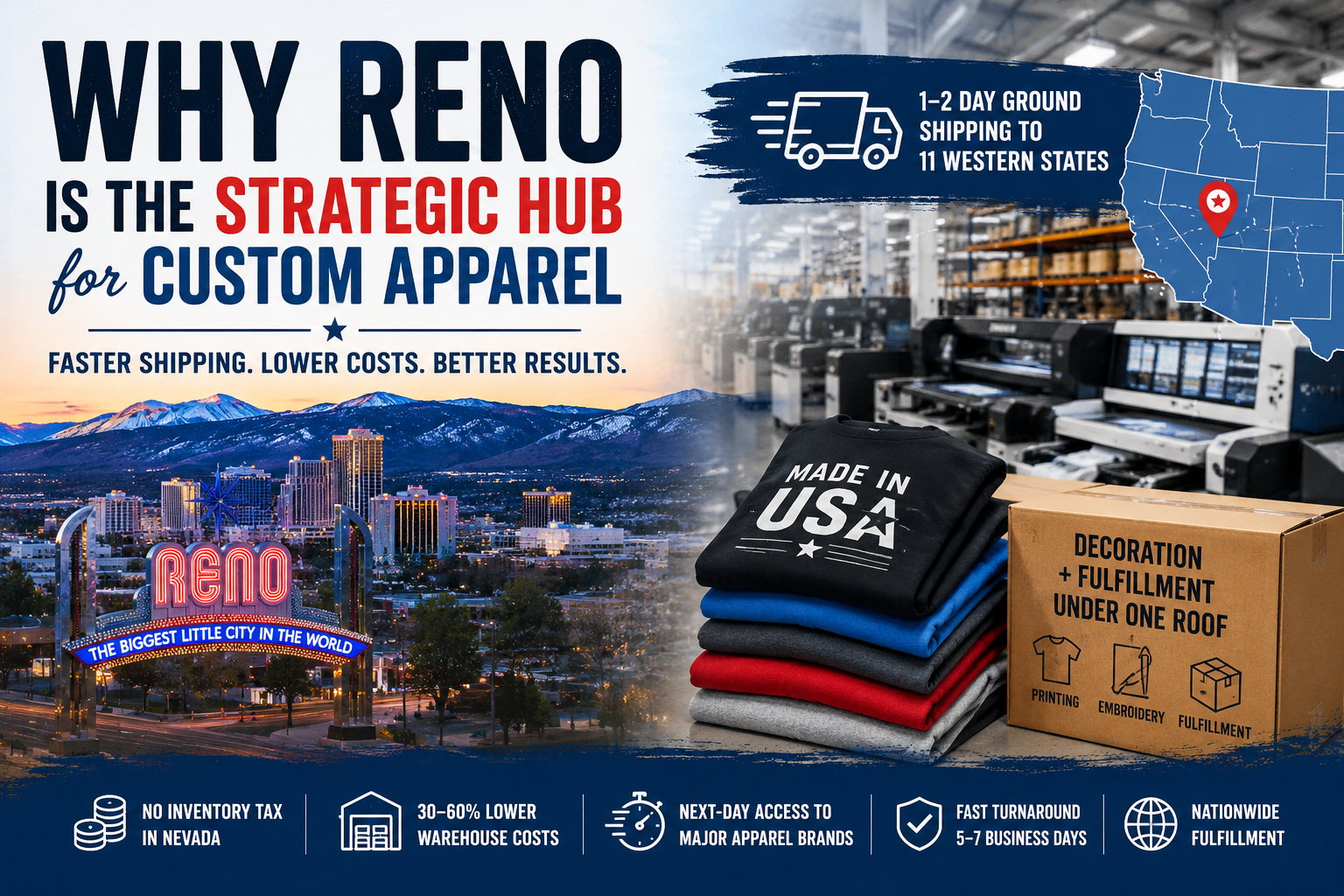
Silverscreen's Reno, NV facility, for instance, sits adjacent to LAT Apparel, S&S Activewear, and SanMar distribution centers, enabling next-day receipt of blanks. The facility also operates as a UPS hub, delivering 1–2 day ground shipping to the 11 western states. That kind of supply chain proximity doesn't happen by accident. It's a deliberate operational advantage that directly benefits clients with tight turnaround requirements.
Does the decorator use technology to manage order transparency?
At high volumes, manual communication doesn't scale. Errors slip through. Timelines get missed. The best contract screen printers invest in proprietary order management technology that gives clients real-time visibility into where their order stands, from proof approval to production to shipment.
A client-facing customer portal for order entry, proofing, and project timeline management eliminates the back-and-forth that slows down large custom apparel orders. As one long-term Silverscreen client noted: "The customer portal is one of my favorite things about the company; it is easy to use for order entry, proofing, and managing project timelines."
How Can You Ensure Consistent Quality on Large Custom Apparel Orders?
Establish clear quality standards before production begins
Quality consistency on large orders starts with alignment, not assumptions. Before production begins, work with your print partner to define:
- Pantone color references for all brand colors
- Print placement tolerances (acceptable deviation from the approved spec)
- Approved garment samples that serve as the physical quality benchmark throughout the run
The more specific your standards, the less room there is for interpretation and variation.
Request mid-production quality checks
A quality inspection at the end of a 10,000-piece run is too late to catch a registration error that appeared at piece 500. High-volume screen printing operations should conduct inspections at defined intervals throughout production. Ask your contract screen printer how they handle mid-run quality control and what happens when a defect is identified.
Understand how the printer handles reprints and replacements
Even with rigorous quality control, issues can arise. A trustworthy contract screen printer has a clear, documented process for handling defects, including reprints and replacements, without passing delays or additional costs onto the client. Ask about this policy upfront, before you're in a position where you need it.
What Production Capacity Should a Screen Printing Partner Have?
For large apparel orders, capacity is about more than press count
Production capacity in custom apparel production isn't just about how many presses a facility operates. True capacity includes:
- Staffing depth — enough skilled decorators to sustain output across multiple shifts
- Physical space — room to receive, sort, print, quality check, and stage large garment volumes without bottlenecks
- Fulfillment infrastructure — the ability to pick, pack, and ship completed garments directly to end recipients if needed
A decoration partner that maxes out their floor during a mid-sized run won't have the bandwidth to absorb spikes, rush orders, or the inevitable complications that come with large-scale production.
Fulfillment services extend your production capability
For brands managing large promotional campaigns, uniform programs, or e-commerce operations, production capacity means nothing without a downstream fulfillment solution. Contract screen printers that offer end-to-end fulfillment, warehousing, inventory management, pick-and-pack, and nationwide shipping allow you to scale your apparel program without adding internal logistics overhead.
This is particularly valuable for growing brands, distributors, and promotional product agencies managing multiple clients simultaneously. One integrated partner handles decoration and delivery. You focus on growth.
Choosing the Right Partner for High-Volume Custom Apparel Production
Scaling large custom apparel orders without sacrificing quality isn't about cutting corners faster. The brands and distributors that scale successfully invest time upfront, vet their print partners thoroughly, establish clear production standards, and build relationships with facilities that have the infrastructure to back up their commitments.
The checklist is simple:
- ✅ Proven high-volume screen printing capacity with two-shift production capability
- ✅ Multiple decoration methods (screen printing, embroidery, DTG, DTF) under one roof
- ✅ Local access to major blank apparel distributors for fast turnaround
- ✅ Proprietary technology for real-time order management and client transparency
- ✅ End-to-end fulfillment services for complete supply chain management
- ✅ Documented quality control processes with mid-production inspection checkpoints
Silverscreen Decoration & Fulfillment has built its operation around exactly these criteria, serving businesses across the country for over two decades with a track record of consistent quality, operational reliability, and client-centered service.
Ready to scale your next custom apparel program with confidence? Contact Silverscreen Decoration & Fulfillment to discuss your project and explore what's possible.
Frequently Asked Questions
What is high-volume screen printing, and when does it make sense?
High-volume screen printing refers to custom apparel production runs that require large quantities of the same design, typically 1,000 units or more. It makes sense when brand consistency, cost efficiency, and fast turnaround across a large quantity of garments are priorities. Screen printing is ideal for bold graphics and vivid colors that need to withstand repeated wash and wear.
How do I find a reliable contract screen printer for large apparel orders?
Look for a contract screen printer with documented production capacity, multiple decoration methods, established supplier relationships for blank garments, and a technology platform for order management. Request references from clients with similar order volumes and ask specifically about their quality control and reprint policies.
How long does it take to fulfill a large custom apparel order?
Timelines vary based on order complexity, garment availability, and production queue. A well-equipped contract screen printing facility with local blank apparel supplier access can often fulfill large orders faster than industry averages. Silverscreen Decoration & Fulfillment's proximity to major distributors like S&S Activewear and SanMar enables next-day blank receipt, significantly reducing lead times.
What's the difference between contract screen printing and working directly with a print shop?
Contract screen printing refers to outsourced custom apparel production, typically used by distributors, promotional product agencies, or brands that don't own printing equipment. The contract printer handles production while the client manages the customer relationship. Working directly with a print shop means the client is the end customer. Many contract screen printers also work directly with brands and businesses of all sizes.
How do I ensure color consistency across a large apparel order?
Color consistency starts with Pantone color references and a proofing process that locks in specifications before production begins. A professional contract screen printer will conduct ink mixing in a controlled environment and perform quality checks throughout the run to catch any variation early.
Can a contract screen printer also handle fulfillment and shipping?
Yes; many established contract screen printers offer end-to-end fulfillment services, including warehousing, inventory management, pick-and-pack, and direct-to-consumer or business shipping. This is particularly useful for e-commerce apparel brands, uniform programs, and large promotional campaigns that require individual shipments to multiple locations.
Have any more questions?
This is the text area for this paragraph. To change it, simply click and start typing.